

The Pokémon Crystal Rare Candy code 9120F2D0 targets the second entry in a shop’s item list. It does not put an unlimited supply of Rare Candies in your bag. The matching Master Ball code targets that same entry, while the commonly shared money cheat needs three lines to represent the full amount.
We checked the addresses against reconstructed data for English Pokémon Crystal versions 1.0 and 1.1, and examined how VBA-M interprets the GameShark codes. Sources were checked on 15 October 2026. This is a static code explanation: we have not tested the cheats in the game. It does not establish compatibility with German Crystal, Gold, Silver, ROM hacks or every emulator.
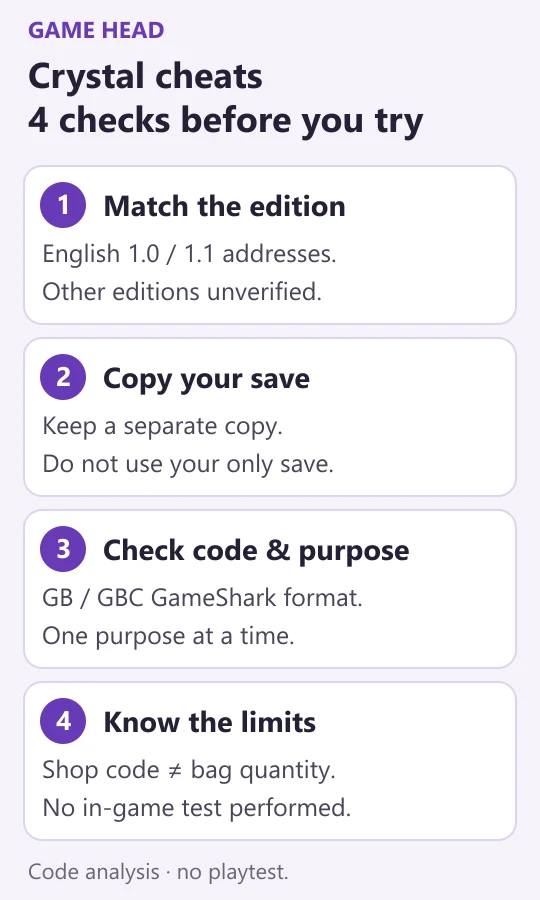
Before trying a code: identify the game and copy your save
Start with the game’s language and revision. An English emulator menu does not prove that the game itself is the English release. A code is a memory write, so a matching game title alone is not enough to show that the address has the intended meaning.
Keep a separate copy of your save file outside the slot you are using. A save state can help with a short experiment, but it is easy to overwrite while playing. Do not make the only copy of a long-running save the starting point for a cheat test.
These examples use eight-character GameShark codes for Game Boy or Game Boy Color. The code-type menu depends on your emulator and version. They are not Game Boy Advance codes. Keep unrelated cheats disabled so you can tell which change produced a result.
What the codes actually target
| Purpose | Code or group | What the source check supports |
|---|---|---|
| Rare Candy shop entry | 9120F2D0 | Writes item ID 20 to the second current-shop item entry; not a bag quantity. |
| Master Ball shop entry | 9101F2D0 | Writes item ID 01 to that same entry; conflicts with the Rare Candy code. |
| Money value 999,999 | 910F4ED891424FD8913F50D8 | Sets the three bytes representing 0F 42 3F; the first line alone is incomplete. |
Static address and byte analysis only. Menu refresh, purchases and the charged price were not tested.
Rare Candy: why a shop code is not an unlimited supply
The item constants identify hexadecimal 20 as Rare Candy. The symbol data places the shop list at D0F1, making D0F2 its second item entry. In VBA-M’s interpretation, 9120F2D0 writes that item value to the corresponding address in WRAM bank 1.
That explains the intended shop-list change. It does not show that the code adds an item directly to your bag or keeps a quantity fixed there. Calling it “infinite Rare Candy” promises more than this code writes.
There is a further reason to avoid leaving it active: the reconstructed RAM layout also places mailbox data at that address. Its meaning depends on what the game is doing. Do not treat a shop-list write as a general background convenience.
If you investigate the code on a separate save, the proposed check is the second item in an ordinary shop’s buying menu. We have not established when that menu refreshes, whether a purchase completes correctly or what price is charged. Stop if the displayed item does not match the intended change. Disable the code before leaving the relevant menu, and restore the separate save if anything behaves unexpectedly.
Master Ball: the same address, a different item
9101F2D0 substitutes hexadecimal item ID 01, which the item constants identify as Master Ball. The target address is the same one used by the Rare Candy example. Enabling both codes does not give you two different shop slots; it makes two writes compete for one slot.
The same limits apply here: the address analysis does not prove a successful purchase or a free item. It also does not establish the effect in another language edition. Keep the version, menu state and actual result separate from what a code’s label claims.
Money: why 910F4ED8 is only part of the amount
The English symbol data identifies the money value at D84E. It occupies three bytes. The amount 999,999 is hexadecimal 0F423F, so the complete byte group is:
910F4ED8
91424FD8
913F50D8
Enter each eight-character code as its own line if your emulator uses a separate entry per code. These three lines belong to one money value. The first line changes only the first byte; it does not specify the remaining two.
This is a fixed value, not mathematical “infinite money.” We verified the arithmetic and target addresses, not the in-game display, spending behaviour or persistence after disabling the codes. Those checks still need an actual gameplay test on the intended version.
Why a code can fail even when it looks right
Check the edition, revision and code type first. Then consider what is currently using the target memory. A correct address for one menu is not necessarily safe throughout the game. Conflicting cheats can also obscure which write caused an unexpected result.
Do not work through unrelated code combinations on your only save to make a failed code “start working.” Return to the separate copy and narrow the question. For these examples, German-language compatibility and practical buying behaviour remain open rather than assumed.
Progress without a cheat
If your aim is to train your team or evolve a particular Pokémon, our guides explain how to obtain the Exp. Share in Gold, Silver and Crystal and where to look for a Fire Stone in those original games. They cover normal game routes rather than memory writes.
Sources and what remains untested
The technical basis is the GB GameShark implementation in VBA-M, English Crystal 1.0/1.1 symbol files, and pokecrystal’s RAM layout, item constants, shop logic and money routines. These are reconstructed source data and emulator code, not footage of a successful test.
Checked on 15 October 2026. We did not run the game or download a ROM for this analysis. Menu refresh, actual purchases, prices, other language editions and emulator-specific behaviour still require direct testing. The checklist above is our own schematic illustration.